

E-Rechnung 2027: How Businesses Can Meet Germany's B2B E-Invoicing Mandate with the Right SAP Add-On

A regulation that will fundamentally reshape German business operations is fast approaching. Starting in 2027, all companies operating in Germany will be legally required to send structured electronic invoices, known as E-Rechnungen. Introduced under the Wachstumschancengesetz (Growth Opportunities Act), this reform goes far beyond a simple digital upgrade. It represents a serious compliance obligation. For businesses running SAP, the right add-on solution can turn this challenge into a strategic advantage.
What Is an E-Rechnung and Why Does 2027 Matter So Much?
An E-Rechnung, as defined by German law, is a structured electronic invoice in machine-readable XML format that conforms to the European standard EN 16931. The key difference from a conventional PDF invoice is fundamental: an E-Rechnung is not a visual document but a structured data package that ERP systems can receive, validate, and process fully automatically without any human intervention.
Germany's E-Rechnung rollout follows a three-phase timeline:
January 1, 2025: All German businesses are required to be able to receive structured e-invoices. Rejecting an electronic invoice from a sender is no longer legally permitted.
January 1, 2027: Companies with an annual turnover exceeding 800,000 euros must send structured e-invoices for all domestic B2B transactions.
January 1, 2028: The sending obligation extends to all businesses regardless of size or revenue.
This regulation closely aligns with the EU's ViDA initiative (VAT in the Digital Age), which aims to standardize real-time digital VAT reporting across all member states. Germany is leading the charge, and businesses that prepare early will be far better positioned as the broader European framework takes shape.
XRechnung or ZUGFeRD? Understanding the Two Core Standards
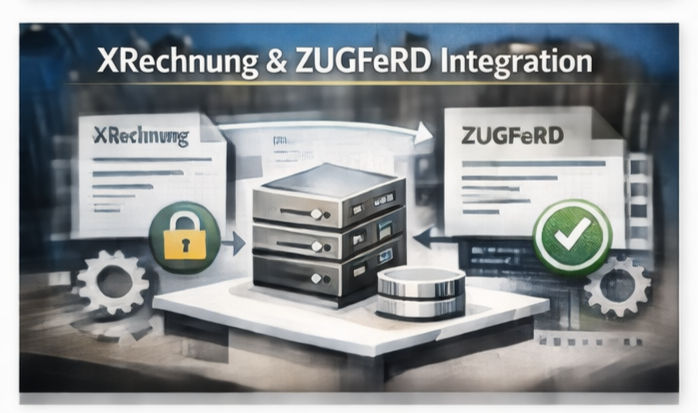
Germany recognizes two primary formats for E-Rechnung compliance. Understanding both is essential for any business planning a smooth SAP integration.
XRechnung
XRechnung is a purely XML-based format that can only be read and processed by software systems. It contains no human-readable visual layer. Public sector invoicing in Germany has required XRechnung for several years already, and the format is set to become the dominant standard in B2B transactions from 2027 onward.
ZUGFeRD
ZUGFeRD (Zentraler User Guide des Forums elektronische Rechnung Deutschland) takes a hybrid approach. It combines a human-readable PDF with an embedded XML data package. This makes ZUGFeRD a highly practical choice during the transition period, particularly for small and medium-sized enterprises that need a format their teams can still read and reference visually.
The critical point: Your SAP system must be able to receive, process, and generate both formats. Standard SAP configurations frequently fall short of these requirements. This is precisely where a dedicated SAP Add-On becomes essential.
5 Common E-Rechnung Compliance Challenges for SAP Users
Companies active in the German market or working with German suppliers and customers regularly encounter the following obstacles in their SAP environments:
1. Format conversion complexity: SAP systems are typically configured to produce PDF output. Generating XRechnung or ZUGFeRD files requires specific technical customization that goes well beyond standard settings.
2. Lack of built-in validation: Without an automated check against EN 16931, non-compliant invoices can be sent and rejected by recipients, creating delays and disrupting cash flow.
3. GoBD-compliant archiving: German tax law mandates that electronic invoices be stored in an unalterable, audit-proof format for defined retention periods. Standard SAP archiving setups do not always meet these requirements out of the box.
4. Managing multiple recipient formats: Different customers may require different formats and delivery channels. Handling these manually is time-consuming and prone to costly errors.
5. Pressure from real-time reporting: As the ViDA framework advances, the obligation to transmit invoice data to tax authorities in real time is drawing closer. Companies need to build systems now that can accommodate this requirement later.
The SAP Add-On Approach: Smarter E-Rechnung Compliance
A purpose-built SAP Add-On addresses all of these challenges from within your existing SAP environment, with no need for third-party middleware or complex external integrations. The core capabilities you should look for include:
Automated format generation: Outgoing invoices are automatically converted into XRechnung or ZUGFeRD based on the recipient's profile. Users need no technical knowledge of the underlying formats.
Built-in validation engine: Every invoice is automatically checked for EN 16931 conformity before dispatch. Non-compliant documents are flagged and the system provides targeted correction guidance.
GoBD-compliant archiving: Invoices are stored in an immutable format within the SAP system, with complete audit trails preserved for the legally required retention periods.
Flexible recipient profile management: Each customer's preferred format and delivery channel (email, Peppol network, or direct API) is defined once in SAP and applied automatically to every transaction.
Real-time status monitoring: Transmission status, confirmations, and rejections are visible at a glance through the familiar SAP interface.
This is exactly what the Melasoft SAP Add-On delivers: a fully integrated solution that closes the compliance gap without disrupting your existing workflows.
Why Waiting Until 2027 Is a Risky Strategy
Many finance and IT teams assume there is plenty of time left. In practice, three years passes quickly when implementation projects are involved.
Projects consistently take longer than expected. E-Rechnung compliance in SAP involves process analysis, system configuration, testing, and user training. Even a well-managed project typically takes three to six months. Leaving it until the last minute puts business continuity at risk.
Customer pressure has already begun. Since January 1, 2025, German companies have been required to accept e-invoices. Large buyers are already pushing their suppliers to deliver compliant invoices. If you work with German business partners, you are likely already hearing this request.
The Peppol network is growing fast. Germany is actively integrating with the pan-European Peppol e-invoicing infrastructure. Early movers gain both compliance assurance and access to a more streamlined, lower-cost invoicing process across borders.
Conclusion: Compliance Is Mandatory. Competitive Advantage Is a Choice.
The E-Rechnung mandate coming into full force in 2027 is a certainty for every business operating in Germany or transacting with German partners. The question is no longer whether to comply, but how to do it in the most efficient and future-proof way possible.
The Melasoft SAP Add-On provides a clear answer: full compliance without replacing your existing SAP investment, and without the operational overhead of managing the complexity yourself. XRechnung and ZUGFeRD support, built-in EN 16931 validation, GoBD-compliant archiving, and seamless integration are all available in a single solution.
Get compliance-ready before 2027. Schedule a no-obligation discovery call with the Melasoft E-Rechnung team today and find out exactly where your SAP system stands.
Melasoft is a software provider specializing in SAP-based business processes with deep expertise in German corporate and tax law. Visit melasoft.com for more information on e-invoicing compliance, digital transformation, and SAP integration solutions.
Tags: E-Rechnung, SAP Add-On, E-Rechnungspflicht 2027, XRechnung, ZUGFeRD, Germany E-Invoicing, SAP Integration, GoBD Compliance, Peppol, ViDA Directive, Wachstumschancengesetz

Comments